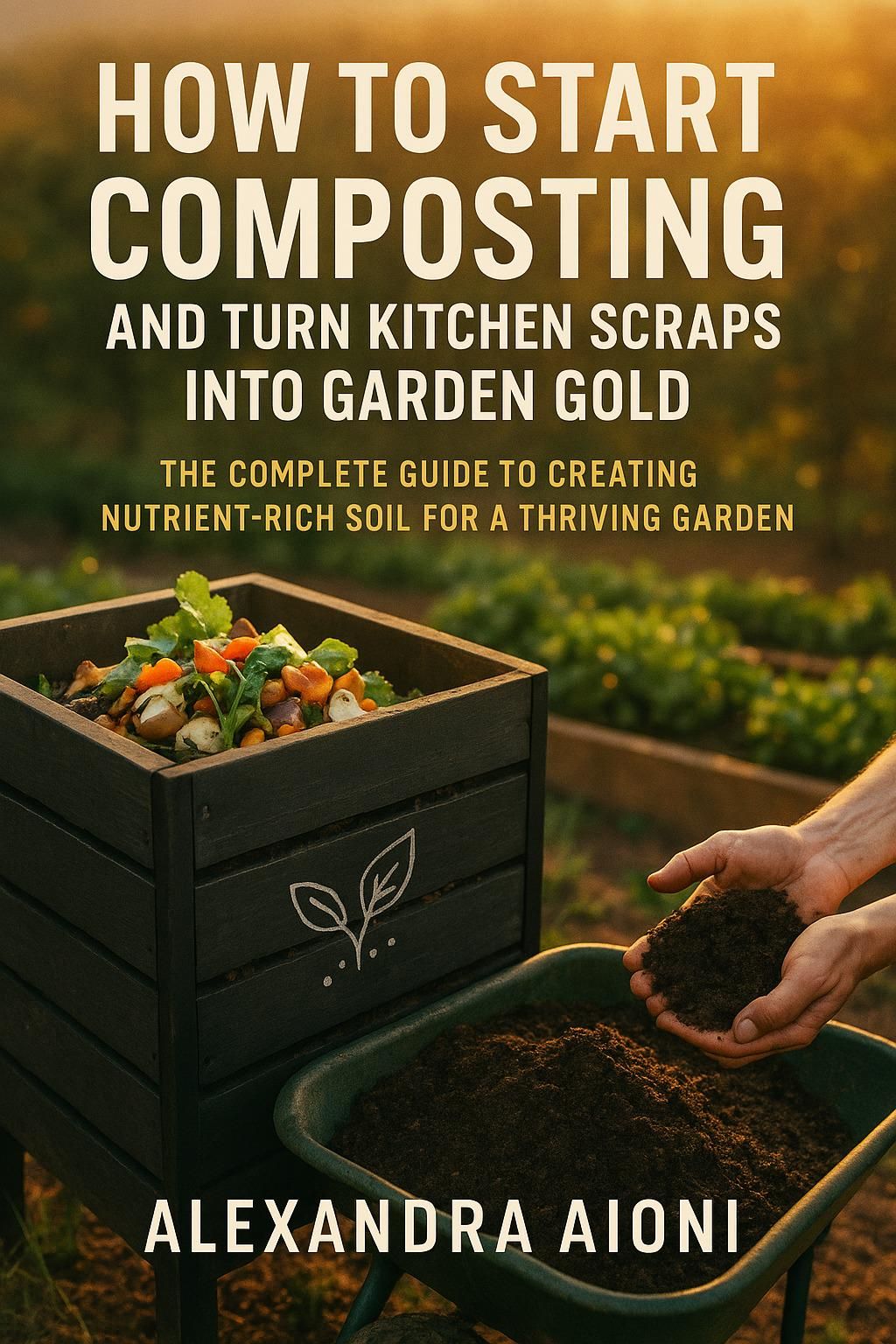

Turn Kitchen Scraps into Garden Gold-Learn composting for beginners — how to turn kitchen scraps and garden waste into rich, free compost for your garden. Step-by-step guide, what to add, common mistakes, and troubleshooting tips.
Every time you peel a carrot, brew a pot of coffee, or tear down a cardboard box — you’re throwing away gold.
Not literally. But in gardening terms, those vegetable peelings, coffee grounds, and cardboard scraps are the raw ingredients of compost — the single most valuable material you can add to your garden soil. Rich in nutrients, teeming with beneficial biology, and completely free to make at home from waste you’d otherwise bin.
Composting for beginners can feel complicated when you first look into it. Greens and browns. Carbon-to-nitrogen ratios. Hot composting versus cold. Turning schedules. Activators.
But here’s the truth: composting is fundamentally simple. Organic material breaks down. You help it along. You get compost. That’s the whole story.
This guide strips away the complexity and gives you everything you actually need to start composting at home — what to add, what to avoid, how to manage your heap, how to fix problems, and how to use the finished compost in your garden.
Let’s turn your kitchen scraps into garden gold.
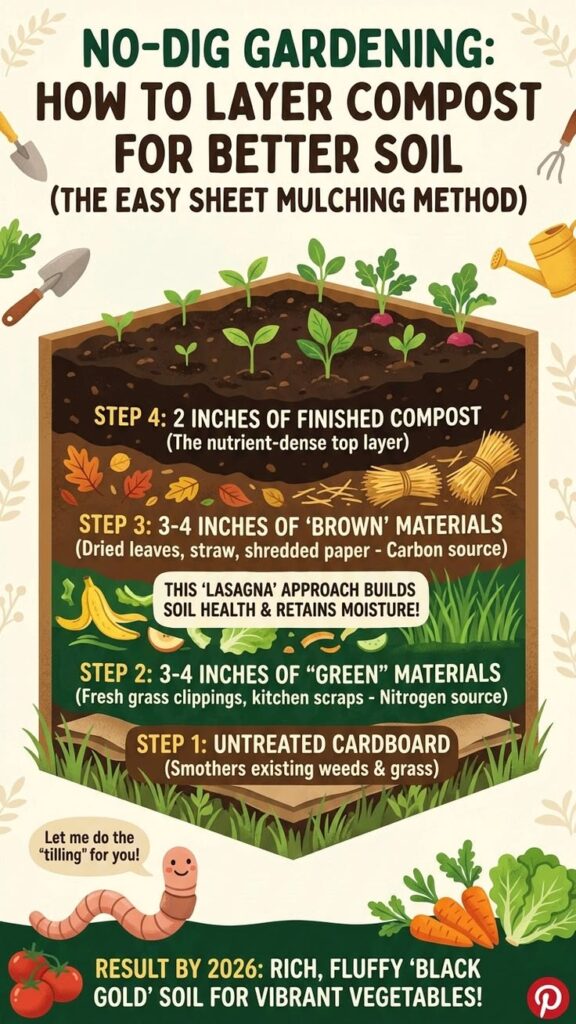
Table of Contents
- Why compost at home?
- What you need to start
- Understanding greens and browns
- What to compost — the complete list
- What never to compost
- Setting up your first compost heap
- How to layer your compost correctly
- Managing your heap day to day
- How to speed up composting
- Composting troubleshooting guide
- How to know when compost is ready
- Using your finished compost
- Composting without a garden
1. Why Compost at Home?
Before we get into the how, let’s make sure the why is absolutely clear — because understanding what compost does makes you a much more motivated composter.
It feeds your garden for free
Compost is a slow-release fertiliser packed with every nutrient plants need — nitrogen, phosphorus, potassium, calcium, magnesium, and dozens of trace minerals. Unlike synthetic fertilisers that deliver a sudden nutrient hit and quickly wash away, compost releases nutrients gradually over months, feeding your plants exactly when and how they need it.
A garden that receives regular applications of homemade compost year after year becomes progressively more fertile, more productive, and more resilient — without spending a penny on bought fertilisers.
It transforms your soil
This is composting’s secret superpower. Compost doesn’t just feed your plants — it fundamentally improves the physical structure of your soil.
Added to sandy soil, it acts like a sponge — binding particles together, dramatically improving the soil’s ability to hold water and nutrients. Added to heavy clay soil, it opens up the dense structure, improving drainage and aeration. Whatever your soil type, compost makes it better. There is genuinely no soil that doesn’t benefit from the regular addition of compost.
It’s completely free
Bagged compost from a garden centre costs £5–10 per bag — and a productive vegetable garden needs a lot of it. A large raised bed alone might need 6–10 bags per year. Making your own costs nothing beyond a modest upfront investment in a bin or some timber for a simple heap.
It reduces your household waste
The average UK household sends around 30–40% of its rubbish to landfill as food and organic waste. Composting this material at home diverts it from landfill — where it would produce methane, a powerful greenhouse gas — and transforms it into something genuinely valuable.
It connects your kitchen to your garden
There’s something deeply satisfying about the closed loop of composting. The vegetable peelings from tonight’s dinner become the compost that feeds the raised bed that grows next summer’s vegetables. Waste becomes resource. The circle completes.
2. What You Need to Start
The great news: you need very little to start composting. Here’s the basic kit.
A composting container or space
Option 1: A compost bin The most common starting point. Plastic compost bins — the classic “dalek” style — are available from most garden centres and often subsidised or free from local councils. They’re simple, contained, and retain heat and moisture better than an open heap.
Check your local council website — many councils sell compost bins at heavily subsidised prices (sometimes as little as £5–10) to encourage home composting.
Option 2: A DIY compost heap Four wooden pallets stood on their sides and secured at the corners make an excellent compost bay for free — pallets are often available at no cost from builders’ merchants, garden centres, or listed free on local community marketplaces.
Option 3: A simple open pile If you have space in an out-of-the-way corner of your garden, a simple open pile works — it’s slower and less tidy than a contained system, but costs nothing and requires zero construction.
A kitchen caddy
A small countertop container — a caddy — to collect kitchen scraps before transferring to your outdoor heap. This means you’re not trudging to the garden every time you peel a potato. Empty it every 1–2 days to prevent odours.
Line it with compostable liners or simply rinse it out between uses. Any container with a lid works — a dedicated food waste caddy, a small bin with a charcoal filter lid, or even a repurposed ice cream tub.
Basic tools
A garden fork or compost aerator for turning and mixing. That’s genuinely all you need beyond the container itself.
3. Understanding Greens and Browns
This is the fundamental concept of composting — and once you understand it, everything else makes sense.
Compost is made by microorganisms — primarily bacteria and fungi — that break down organic material. To work efficiently, these microorganisms need two types of material in roughly equal balance:
Greens (nitrogen-rich materials)
Greens provide the nitrogen that microorganisms need to grow, reproduce, and drive the decomposition process. They’re typically moist, fresh, and soft.
Examples: vegetable and fruit scraps, fresh grass clippings, coffee grounds, tea leaves, fresh plant trimmings, fresh weeds (not seeded).
Browns (carbon-rich materials)
Browns provide the carbon that gives microorganisms their energy. They’re typically dry, woody, and structural.
Examples: cardboard, dry leaves, straw, paper, wood chip, dry plant stems, eggboxes.
The ratio that works
The ideal carbon-to-nitrogen ratio for efficient composting is roughly 25-30 parts carbon to 1 part nitrogen. In practical terms, this means adding roughly equal volumes of greens and browns — perhaps with a slight bias toward browns.
Too many greens: The heap becomes wet, slimy, and starts to smell unpleasant. Fix by adding lots of torn cardboard or dry leaves.
Too many browns: The heap becomes dry and inactive — decomposition slows dramatically. Fix by adding fresh greens and a splash of water.
The right balance: An active heap that heats up, breaks down steadily, and smells pleasantly earthy.
The single most useful thing you can do is keep a supply of torn cardboard or dry leaves next to your compost bin. Every time you add a batch of kitchen scraps (greens), follow it immediately with a handful of torn cardboard (browns). This one habit keeps most heaps in perfect balance.
4. What to Compost — The Complete List
Kitchen scraps (greens)
- Fruit and vegetable peelings and scraps of all kinds
- Banana skins, apple cores, citrus peel
- Tea bags (check they’re plastic-free — many brands now make fully compostable bags) and loose tea leaves
- Coffee grounds and paper coffee filters
- Eggshells (technically neutral, not green — but extremely beneficial, add calcium)
- Stale bread and grains (bury in the centre to avoid attracting pests)
- Hair and nail clippings
Garden waste (greens)
- Fresh grass clippings (add in thin layers — thick clumps mat together and go slimy)
- Fresh plant trimmings and prunings (soft, green growth)
- Annual weeds — before they set seed
- Spent plants after harvest
- Fresh leaves and soft hedge trimmings
Paper and cardboard (browns)
- Cardboard boxes — torn or shredded, soaked if very dry (excellent brown, use generously)
- Newspaper and plain paper — scrunched or shredded
- Paper bags, paper towels, paper napkins
- Cardboard egg boxes and egg cartons
- Toilet roll and kitchen roll tubes
- Cereal boxes (remove any plastic window)
Garden browns
- Dry autumn leaves — shred if possible to prevent matting
- Straw and hay
- Wood chip and bark (from untreated wood)
- Dry plant stems broken into shorter lengths
- Twigs (small ones — larger ones take too long to break down)
Other compostable materials
- Natural fibre materials — cotton, wool, jute — cut into small pieces
- Wood ash from log fires or wood-burning stoves (in small quantities — don’t overdo it)
- Pet bedding from herbivores — hay, paper bedding from rabbits, guinea pigs, hamsters
- Vacuum cleaner dust (from natural fibre carpets)
- Compostable packaging (certified — look for the seedling logo)
5. What Never to Compost
Some materials don’t belong in a home compost heap. Adding them causes problems ranging from unpleasant odours to pest infestations to spreading disease through your garden.
Absolute no-gos
Meat, fish, and bones — attract rats, mice, and other vermin. Create powerful, persistent odours. Take very long to break down even in ideal conditions.
Dairy products — same problems as meat. Cheese, butter, milk, yoghurt — all go in the bin, not the compost.
Cooked food — especially fatty or highly processed food. Cooked food attracts vermin and breaks down in ways that create odour problems.
Dog and cat waste — contains pathogens (including potentially harmful bacteria and parasites) that a cool home compost heap won’t reliably destroy. Use a dedicated pet waste digester instead.
Diseased plant material — if plants have had serious fungal diseases (tomato blight, rose black spot, clubroot in brassicas), bin the affected material rather than composting it. A cool heap won’t reliably kill many plant pathogens, which can then spread when you use the compost.
Weeds that have set seed — unless your heap gets genuinely hot (60°C+), seeds survive composting and will germinate wherever you spread your compost. Perennial weed roots — bindweed, couch grass, ground elder — also survive and spread.
Treated or painted wood products — the preservatives and paints don’t belong in your garden soil.
Glossy or heavily printed paper — the coatings and inks don’t break down cleanly. Plain cardboard and newspaper is fine; glossy magazine pages are not.
Coal ash — contains sulphur compounds harmful to soil biology. Wood ash in small quantities is fine; coal ash never.
Citrus peel in very large quantities — small amounts are fine, but a heap dominated by citrus peel becomes too acidic and can repel the worms you want.
6. Setting Up Your First Compost Heap
Location
Place your compost bin or heap:
On bare soil — not on concrete or paving. The soil connection allows worms and beneficial organisms from the ground to enter the heap from below. These are the workers that will help break everything down.
In partial shade — full sun dries the heap too quickly and makes moisture management harder. Deep shade slows the process. A spot that gets a few hours of sun but is shaded during the hottest part of the day is ideal.
Within reasonable reach of your kitchen — because you’ll be carrying kitchen scraps to it regularly. A compost bin 200 metres away at the bottom of a long garden gets visited much less often than one just outside the back door.
Away from boundaries — give it a little space from fences and walls, both for access and because a well-managed heap can get warm.
Starting your heap
Step 1: If using a plastic bin, position it on bare soil and firm it down slightly so there are no gaps between the base and the ground.
Step 2: Begin with a base layer of coarse material — small twigs, scrunched cardboard, or straw. This creates drainage and airflow at the very bottom of the heap, which helps prevent the base becoming waterlogged and anaerobic.
That’s it. Your heap is started. Now it’s just a matter of adding to it regularly and managing it correctly.
7. How to Layer Your Compost Correctly
Think of building a compost heap like making a lasagne — alternate layers of different materials build a balanced, well-structured heap that decomposes efficiently.
The layering pattern
Layer 1 (base): Coarse brown material — twigs, scrunched cardboard. 5–10cm thick.
Layer 2: Green material — kitchen scraps, fresh garden waste. 5–10cm thick.
Layer 3: Brown material — torn cardboard, dry leaves, straw. 5–10cm thick.
Layer 4: Green material. 5–10cm thick.
Continue alternating until the heap is full.
The practical reality
You don’t need to be precise about this. The layering principle simply means: every time you add a batch of green, wet kitchen scraps, cover them with a layer of dry, brown material. That’s the whole pattern in practice.
Keep a bag or box of torn cardboard next to your compost bin. Every time you open the lid to add scraps, grab a handful of cardboard and throw it on top. This one habit handles the green-brown balance automatically.
Adding water
New heaps sometimes need a little water to get started, especially in dry weather. The heap should feel like a well wrung-out sponge throughout — moist but not dripping. If it looks dry and pale, add water with a watering can and mix it in.
In wet weather or winter, a cover (lid or piece of old carpet) prevents the heap becoming waterlogged.
8. Managing Your Heap Day to Day
Composting is a low-maintenance activity — but a little regular attention produces dramatically better results than complete neglect.
Daily (30 seconds)
Add your kitchen caddy contents to the heap. Cover with a handful of browns. Replace the lid.
That’s genuinely all the daily management required.
Weekly (5 minutes)
Check the moisture level — push your hand into the heap. It should feel moist throughout. Add water if dry; add browns and turn if very wet.
Check for any smells — a good heap smells earthy and pleasant. Any sour or ammonia smell signals an imbalance (see troubleshooting below).
Monthly (15–20 minutes)
Turn the heap with a garden fork — moving outer material to the centre and inner material to the outside. This introduces oxygen, which supercharges the aerobic bacteria and significantly speeds decomposition.
You don’t have to turn every month — many gardeners turn rarely or never and still produce good compost eventually. But turning is the single most effective thing you can do to accelerate the process.
9. How to Speed Up Composting
A well-managed heap can produce finished compost in 2–3 months. A neglected one might take 18 months. These techniques push you toward the faster end:
Chop and shred everything
Smaller pieces have more surface area for microorganisms to work on. Chop kitchen scraps into pieces rather than adding whole fruit and vegetables. Tear cardboard into hand-sized pieces rather than adding whole boxes. Run a lawnmower over fallen leaves before adding them.
This one change alone can halve your composting time.
Turn frequently
Turning introduces oxygen. Oxygen feeds aerobic bacteria — the fast-working decomposers. A heap turned every 1–2 weeks produces finished compost dramatically faster than one never turned. The classic hot composting method turns every 3–5 days and produces finished compost in as little as 4–6 weeks.
Add a natural activator
Compost activators introduce or boost the microorganisms that drive decomposition:
Nettles — one of the very best natural activators. Add a generous handful of fresh nettles to your heap each time you turn it.
Comfrey leaves — extremely rich in nutrients, breaks down rapidly, and provides an excellent nutrient boost to the heap.
Fresh grass clippings — high nitrogen content heats the heap quickly. Add in thin layers to avoid matting.
A shovelful of finished compost or good garden soil — introduces billions of the right microorganisms instantly. If you’re starting a new heap, a contribution from a neighbour’s established heap is invaluable.
Human urine — genuinely effective and completely free. Dilute 1 part urine to 10 parts water and water onto the heap. High in nitrogen, sterile when fresh, and one of the most effective activators available.
Keep it covered
A covered heap retains heat and moisture — both of which accelerate decomposition. In cold weather, insulating the outside of your heap with straw bales, old carpet, or bubble wrap keeps temperatures higher and composting active for longer into autumn.
Build a big heap at once
Microorganisms generate heat as they work — and a larger mass retains that heat better. A heap that reaches 1 cubic metre or more can sustain temperatures of 50–70°C in the centre, which dramatically speeds decomposition and kills weed seeds and pathogens. Smaller heaps are cooler and slower.
If you have a lot of material available at once — after clearing the garden, mowing the lawn, or receiving a delivery of wood chip — build a large heap all at once rather than adding gradually. This is the foundation of the hot composting method.
10. Composting Troubleshooting Guide
Problem: Heap smells like rotting eggs or sewage
Cause: Too many greens, too wet, not enough air — the heap has gone anaerobic (airless). Anaerobic bacteria produce hydrogen sulphide — the rotten egg smell.
Fix: Add a generous quantity of browns (torn cardboard works instantly), turn the heap thoroughly to introduce air, and check that the base isn’t waterlogged. The smell should improve within 24–48 hours.
Problem: Heap smells like ammonia
Cause: Too much nitrogen — typically from excess fresh grass clippings or too many food scraps without enough carbon material.
Fix: Add lots of browns and turn. The excess nitrogen is escaping as ammonia gas — you’re literally losing valuable nutrients. Balance with more carbon material.
Problem: Heap is completely dry and inactive
Cause: Not enough moisture, or too many dry brown materials without enough greens.
Fix: Add water thoroughly (the heap should feel like a wrung-out sponge throughout), add fresh greens, and turn to mix moisture evenly. In very dry weather, cover with a lid to retain moisture.
Problem: Nothing seems to be decomposing
Cause: Could be too dry (see above), too cold (winter slowdown is normal), too many browns without enough greens, or materials added are too large to break down quickly.
Fix: Check moisture, add greens and an activator, chop materials more finely before adding, and be patient — very cold weather genuinely does slow composting to a near halt.
Problem: Heap is full of flies
Cause: Fresh food scraps left exposed on the surface where flies can access them and lay eggs.
Fix: Always bury fresh kitchen scraps in the centre of the heap (not just dropped on top) and cover immediately with browns. A well-fitting lid prevents flies accessing the heap. Avoid adding very ripe or fermenting fruit in warm weather if flies are a persistent problem.
Problem: Rats or mice in the heap
Cause: Food scraps — particularly cooked food, meat, or dairy — attracting vermin.
Fix: Never add meat, dairy, or cooked food to a home heap. If vermin are established, you may need a rodent-proof bin with a solid plastic base and fine mesh lining around the sides. Surround the base of an open heap with fine wire mesh buried 30cm into the ground to prevent burrowing.
Problem: Compost is full of weed seedlings when I use it
Cause: Weed seeds in the heap weren’t killed because the heap wasn’t hot enough.
Fix: Avoid adding weeds that have set seed. For future batches, turn more frequently to generate heat, or leave finished compost spread in a thin layer in the sun for a few weeks — the warmth and light will germinate and kill weed seeds before they reach your beds.
Problem: Heap has slowed dramatically in winter
Cause: Cold temperatures reduce microbial activity significantly — below 10°C, decomposition slows considerably; near freezing, it stops almost entirely.
Fix: This is completely normal and not a problem. Continue adding material through winter. Insulate the outside of the heap to retain what heat is generated. Activity will resume naturally in spring as temperatures rise. Winter is a good time to add large quantities of cardboard and woody materials that will have time to break down slowly.
11. How to Know When Compost Is Ready
Finished compost is easy to recognise:
Appearance: Dark brown to black — like rich, dark chocolate cake. Uniform in colour and texture. You should not be able to recognise the original materials. No visible vegetable peelings, no identifiable cardboard pieces.
Texture: Crumbly and loose — it falls apart easily in your hands rather than sticking together in clumps. Not slimy, not compacted, not fibrous.
Smell: Genuinely pleasant — rich, earthy, and sweet. Like the smell of woodland soil after rain. This is one of the most reliable indicators: good finished compost smells wonderful.
Temperature: A finished heap has cooled down. If the centre is still noticeably warm, active decomposition is still happening and it needs more time.
Worm activity: Mature compost is often full of worms — a sign of biological richness and a very good indicator that the material is well-decomposed.
What to do if it’s not all finished
It’s common for compost to be finished in parts but not others — typically the older, deeper material is ready while newer additions are still breaking down. Sieve your compost through a simple garden sieve or piece of wire mesh:
- Material that passes through: Finished compost, ready to use
- Material that doesn’t pass through: Return to the heap for another cycle
12. Using Your Finished Compost
Your compost is ready. Here’s how to put it to work in your garden:
As a soil improver (most important use)
Dig 5–10cm of finished compost into vegetable beds each spring before planting. This replenishes nutrients depleted by the previous year’s crops, improves soil structure, feeds soil biology, and sets up your growing season for success.
For established beds you don’t want to dig, spread compost on the surface as a mulch (see below) and let worms pull it into the soil naturally — this is the “no-dig” approach championed by many modern gardeners.
As a mulch
Spread a 5cm layer of compost on the surface of planted beds, around the base of plants and trees. This suppresses weeds, retains soil moisture, regulates soil temperature, and slowly feeds the soil as rain washes nutrients down. Apply in spring and again in autumn.
In containers and raised beds
Mix homemade compost with peat-free potting compost for container growing — a 30–40% compost content gives excellent results for most vegetables and herbs.
For raised beds, add a generous layer of compost to the surface each year to replenish nutrients and maintain the growing medium’s structure and fertility.
As a lawn top dressing
Sieve compost finely and rake a thin layer (no more than 1cm) over your lawn in autumn. Improves soil structure beneath the grass, feeds it naturally, and over time levels out minor bumps and hollows.
To make compost tea
Steep finished compost in water for 24–48 hours, strain, and use the resulting liquid as a gentle liquid fertiliser for plants. A simple, free plant feed made entirely from your own garden waste.
13. Composting Without a Garden
Don’t have an outdoor space? You can still compost — and benefit from it.
Worm composting (vermicomposting)
A worm bin can live on a balcony, in a garage, under the kitchen sink, or in any reasonably warm space. Special composting worms — red wigglers or brandling worms — live in a contained bin and process your kitchen scraps into worm castings: the most nutrient-dense natural fertiliser you can produce at home.
Worm bins are odourless when managed correctly, process food waste faster than a traditional heap, and fit in very small spaces. The liquid that drains from the bin — “worm tea” — is a potent liquid fertiliser, diluted 10:1 with water before use.
We cover worm composting in detail in a dedicated guide — Worm composting for beginners.
Bokashi composting
Bokashi is a Japanese fermentation system that processes all kitchen waste — including meat and dairy that can’t go in a regular heap — in a sealed bucket using beneficial microorganisms. The fermented material is then buried in soil or added to a traditional heap to finish composting.
It’s completely odourless, works in an apartment, and processes waste that standard composting can’t handle. A good option for households with no outdoor space but who want to compost everything.
Community composting
Many urban areas have community composting schemes — shared heaps in parks or allotments where residents can drop off kitchen scraps and collect finished compost. Check your local council website or community notice boards.
Final Thoughts
Composting is one of the most genuinely transformative things you can do for your garden — and one of the most satisfying eco-friendly habits you can build at home.
It takes a few minutes of attention each week. It costs nothing after the initial setup. And within a few months, it gives you back something more valuable than anything you could buy in a bag at a garden centre.
Start today. Set up a bin, collect your first kitchen scraps, add some torn cardboard, and let nature do the rest.
Your garden will thank you in ways that last for years.
Happy composting, Sajjad
Read these next:
- What Is Composting? (And Why Every Gardener Absolutely Needs It)
- Best soil for vegetable gardens: what to use and why
- How to start a vegetable garden from scratch