
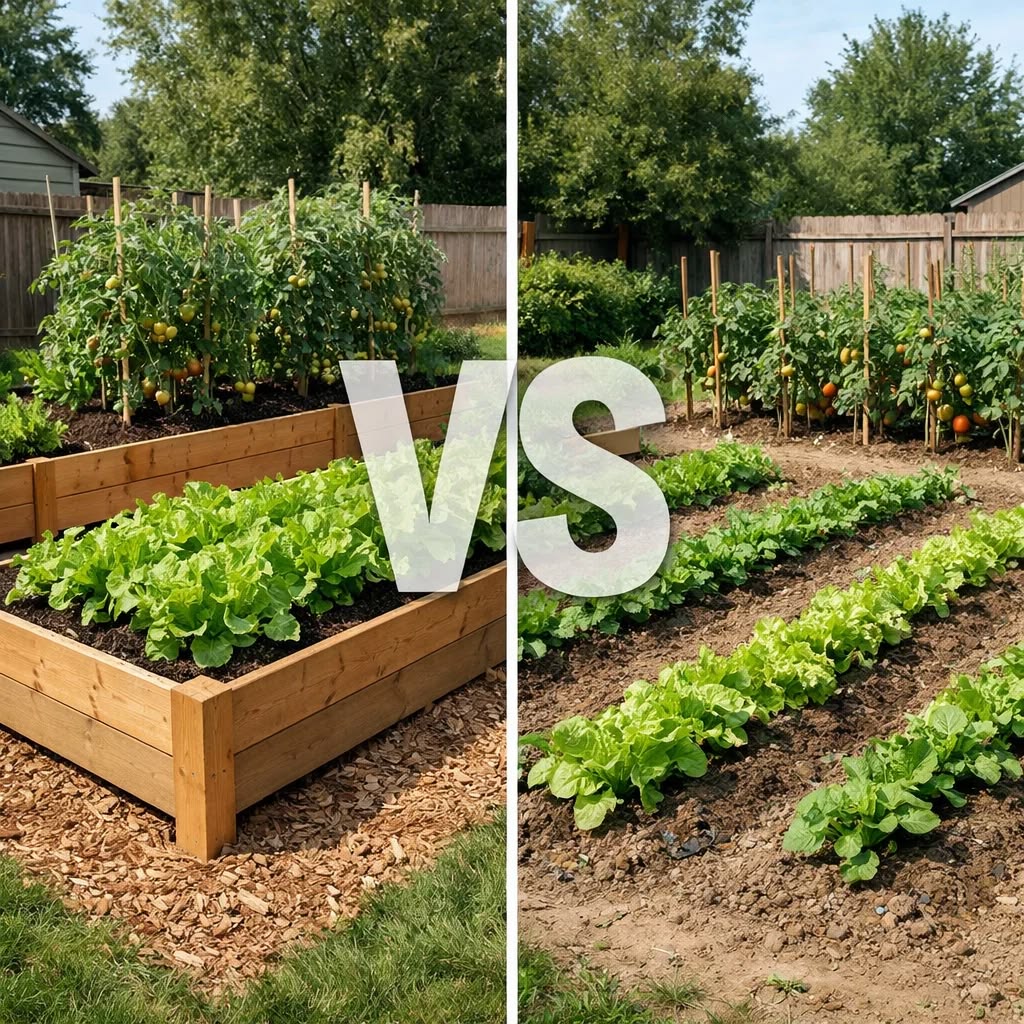
Raised bed vs in-ground garden — which should you choose? This honest beginner’s guide compares both methods on cost, effort, soil, drainage, and results so you can make the right choice.
It’s one of the most common questions beginners ask when they’re planning their first vegetable garden:
Should I build a raised bed, or just dig up the ground?
Both approaches grow excellent vegetables. Both have passionate advocates. And both have genuine advantages that make them the right choice — depending on your situation, your budget, your soil, and how much effort you want to put in upfront.
This guide gives you an honest, no-nonsense comparison of raised beds versus in-ground growing. By the end, you’ll know exactly which approach is right for you — and how to get started with whichever you choose.
Table of Contents
- What is a raised bed?
- What is in-ground gardening?
- Raised bed vs in-ground: the honest comparison
- Cost comparison
- Soil quality and control
- Drainage
- Weed control
- Pest and disease management
- Ease of use and accessibility
- What you can grow
- Which is better for beginners?
- How to get started with raised beds
- How to get started with in-ground growing
1. What Is a Raised Bed?
A raised bed is a growing area built above the existing ground level — typically a frame made from wood, metal, or recycled materials, filled with a specially prepared growing mix of compost and topsoil.
Raised beds sit on top of the ground rather than in it. They can be any size, though the classic dimensions — 1.2 metres wide by 2.4 metres long — are popular because you can reach the centre from either side without stepping on the soil.
They range from simple structures you can build in an afternoon with basic tools and untreated timber, to elaborate cedar or galvanised steel beds that look stunning and last for decades.
The key feature of a raised bed is that you control everything that goes into it — the soil, the compost, the drainage. You’re essentially starting from scratch with a perfect growing environment rather than working with whatever nature gave you.
2. What Is In-Ground Gardening?
In-ground gardening is the traditional approach — you dig up a patch of existing ground, improve it with compost and organic matter, and plant directly into the native soil.
It’s how gardens have been grown for thousands of years. No frames, no imported soil, no upfront construction. You work with what’s already there, improving it season by season through the addition of compost and good cultivation practices.
In-ground gardening requires more initial soil preparation if your ground is poor or compacted — but in return, it has essentially no upfront materials cost, scales to any size, and can produce extraordinary results once the soil is properly established.
3. Raised Bed vs In-Ground: The Honest Comparison
Rather than declaring one method the winner outright, let’s look at how they compare across the factors that matter most to beginner gardeners.
4. Cost Comparison
Raised beds
Raised beds have an upfront cost that in-ground growing simply doesn’t. You need:
- The frame itself — timber, metal, or recycled materials. A basic 1.2m x 2.4m timber raised bed costs £30–80 in materials if you build it yourself, or £60–200+ for a kit.
- Soil and compost to fill it — this is often the biggest expense. Filling a raised bed requires significant quantities of topsoil, compost, and organic matter. A standard raised bed needs roughly 200–400 litres of growing mix depending on depth. Budget £30–100 for fill materials.
- Total first-year cost: £60–300 depending on size, materials, and quality.
Over time, raised beds pay for themselves many times over through reduced weed control effort and better harvests — but the upfront investment is real.
In-ground growing
The upfront cost of in-ground growing is dramatically lower:
- Compost to improve the soil — £15–40 per season for a medium-sized plot
- Basic tools — spade, fork, rake — £20–60 if you don’t already have them
- Total first-year cost: £35–100
Winner on cost: In-ground growing — significantly cheaper to start, especially for larger areas.
5. Soil Quality and Control
Raised beds
This is where raised beds win most convincingly. When you fill a raised bed, you choose exactly what goes in — you create the perfect growing environment from day one. Rich, well-draining, weed-seed-free, perfectly balanced compost and topsoil mix.
This is transformative if your native soil is poor. Heavy clay, compacted subsoil, thin chalky ground, contaminated urban soil — none of it matters when you’re growing in a raised bed, because your plants never touch the native ground. They grow entirely in the imported growing mix you’ve provided.
In-ground growing
In-ground growing is only as good as your existing soil — and improving poor native soil takes time. Heavy clay takes several seasons of compost additions to become truly workable. Sandy soil needs consistent organic matter additions to hold nutrients and moisture.
If you’re fortunate enough to have naturally good loamy soil, in-ground growing works beautifully from the start. If your soil is poor, expect to spend several seasons improving it before seeing the best results.
Winner on soil quality and control: Raised beds — especially on poor native soil.
6. Drainage (Bed vs In-Ground Garden)
Raised beds
Excellent drainage is one of the defining advantages of raised beds. Because they sit above ground level and are filled with a loose, open growing mix, water drains through freely. Raised beds almost never become waterlogged, even in prolonged wet weather — the excess water simply drains down through the base into the ground below.
This makes raised beds particularly valuable in gardens with heavy clay soil or low-lying areas prone to waterlogging.
In-ground growing
Drainage in an in-ground garden depends entirely on your native soil. Free-draining sandy soil poses no problem. But heavy clay or compacted ground can hold water badly — and waterlogged soil is toxic to most vegetable roots, which need oxygen in the soil as much as they need water.
Improving drainage in an in-ground garden takes time and significant additions of organic matter, horticultural grit, and sometimes more structural interventions like drainage channels.
Winner on drainage: Raised beds — consistently superior, especially on difficult ground.
7. Weed Control
Raised beds
Raised beds have a significant weed control advantage in the early years. Because you’re filling them with bought-in growing mix rather than native soil, you’re starting with a weed-seed-free environment. The main source of weeds in a raised bed is wind-blown seeds settling on the surface — which is far fewer than the millions of weed seeds lying dormant in native garden soil.
Additionally, the contained nature of a raised bed makes it easy to see and remove weeds before they establish — and the deep, loose soil makes pulling them out (roots and all) much easier than in compacted ground.
Over time, weeds do find their way into raised beds — but weed pressure remains lower than in-ground growing throughout the life of the bed.
In-ground growing
Native garden soil contains an enormous seed bank — millions of dormant weed seeds waiting for the light and disturbance of cultivation to germinate. Every time you dig the soil, you bring a fresh batch to the surface. Weed pressure in an in-ground garden, particularly in the first few years, can be significant and requires consistent management.
A deep mulch of compost or straw on the surface helps suppress weeds considerably, but in-ground growing generally requires more weeding effort than raised beds — particularly early in the season.
Winner on weed control: Raised beds — especially in the first few years.
8. Pest and Disease Management
Raised beds
The contained, elevated nature of raised beds offers some practical pest control advantages. Slug barriers — copper tape, wool pellets, physical barriers — are much easier to apply around a defined raised bed frame than across an open ground-level garden. Fine mesh covers to exclude cabbage white butterflies and carrot fly are simpler to fit over a raised bed.
Some gardeners also line the base and sides of raised beds with fine wire mesh to exclude burrowing rodents like voles.
In-ground growing
Pests move freely through in-ground gardens, and physical barriers are harder to implement effectively across an open ground-level plot. Slugs, in particular, can be more of a challenge in in-ground beds — especially in heavier, moister soils.
Disease-wise, raised beds offer one significant advantage: better drainage means less fungal disease, particularly the soil-borne diseases encouraged by waterlogged conditions.
Winner on pest and disease management: Raised beds — easier to implement physical barriers and better conditions for disease prevention.
9. Ease of Use and Accessibility
Raised beds
Raised beds are significantly easier on your body. Because the growing surface is elevated — typically 20–45cm above ground level — you do far less bending and kneeling than in-ground gardening requires. This makes raised beds the clear winner for anyone with back problems, limited mobility, or joint pain.
Raised beds can also be built taller — 60–90cm high — for fully accessible gardening with no bending at all. This opens up vegetable growing to people who might otherwise find it physically impossible.
The loose, deeply cultivated soil in a raised bed is also much easier to work with a trowel or hand fork than compacted native ground — planting, transplanting, and harvesting all require less effort.
In-ground growing
In-ground gardening involves considerably more physical work — digging, cultivating, and weeding all require more effort when working at ground level with native soil. For gardeners who are fit and find the physical activity enjoyable, this is no disadvantage. For those with physical limitations, it can be a significant barrier.
Winner on ease of use: Raised beds — dramatically less bending and physical effort.
10. What You Can Grow
Raised beds
You can grow almost anything in a raised bed — all the standard vegetables, herbs, salad crops, and cut flowers. The main limitation is depth: some root vegetables (parsnips, long carrots) need deeply cultivated ground and benefit from raised beds that are at least 30cm deep, ideally 45cm.
Fruit trees and large perennial plants are generally better suited to in-ground growing where roots can spread freely.
In-ground growing
In-ground growing suits all vegetables equally, and has a particular advantage for crops that develop extensive root systems — parsnips, potatoes, squash, and climbing beans all do extremely well in properly prepared in-ground beds.
Large fruiting plants and perennials — raspberry canes, strawberry beds, asparagus — are often better established in-ground where they can spread naturally.
Winner on what you can grow: Tie — both methods grow all the same crops, with minor practical differences for very deep-rooted or large perennial plants.
11. Which Is Better for Beginners?
Here’s the honest answer:
For most beginners, raised beds are the better starting point — and here’s why:
The ability to control your growing medium completely means you’re not fighting your native soil from day one. You fill the bed with perfect growing mix and start with an immediate advantage. Fewer weeds, better drainage, easier cultivation, and less bending all mean a more enjoyable first experience.
The higher upfront cost is a real consideration — but a single 1.2m x 2.4m raised bed is genuinely enough space to grow a meaningful amount of food and learn the fundamentals of vegetable gardening without overwhelming investment.
However, in-ground growing is the better choice if:
- You have a large area to cover and budget is a significant constraint
- You already have good, well-draining loamy soil
- You enjoy the more physical, traditional style of gardening
- You want to grow large quantities of root vegetables or establish permanent fruiting beds
- You’re renting and can’t invest in permanent structures
The best approach for many beginners: Start with one or two raised beds for salad crops, herbs, and tomatoes — where the controlled environment makes the biggest difference — while also preparing an in-ground bed for beans, peas, courgettes, and squash, where plants are more forgiving of variable soil conditions.
This hybrid approach gives you the best of both worlds without the full cost of raised beds for everything.
12. How to Get Started With Raised Beds
Choose your size and location
The most practical starter size is 1.2m wide x 2.4m long x 30cm deep. Wide enough to reach the middle from either side, long enough to fit a good variety of crops, and deep enough for most vegetables.
Choose the sunniest spot available — at least 6 hours of direct sun daily.
Materials for the frame
Untreated softwood timber (25mm thick, 200mm wide) — affordable, easy to work with, and lasts 5–10 years. Avoid treated timber — the preservatives can leach into soil and crops.
Hardwood timber (oak, larch, cedar) — more expensive but lasts 15–25 years without treatment. A long-term investment worth making if budget allows.
Galvanised steel raised bed kits — very long-lasting, look excellent, and are available in many sizes. More expensive than timber but increasingly popular.
Recycled materials — old railway sleepers (check they’re not treated with creosote), reclaimed bricks, stone, or even stacked logs work well and cost very little.
What to fill it with
The classic raised bed filling formula:
- 60% good quality topsoil — buy from a reputable landscape supplier
- 30% garden compost or peat-free multipurpose compost
- 10% perlite or horticultural grit for drainage
Mix thoroughly as you fill. Water well and allow to settle for a few days before planting — the mix will compress slightly and you may need to top up.
The no-dig approach
Many gardeners fill raised beds using a “no-dig” or “lasagne” layering method:
- Place cardboard directly on the grass or ground inside the bed frame (no digging needed — the cardboard suppresses the existing vegetation)
- Add a thick layer of compost (10–15cm)
- Add a layer of straw or wood chip
- Add another thick layer of compost
- Top with a final layer of quality compost for planting
This builds fertility from the bottom up as the layers decompose, and is a genuinely excellent method for filling new raised beds with less bought-in material.
13. How to Get Started With In-Ground Growing
Mark out your plot
Decide on the size and shape of your growing area. A rectangle is easiest to manage. Mark the edges with string lines, hosepipe, or sand.
A good beginner size is 3m x 2m — large enough to grow a meaningful variety of crops, small enough to manage without feeling overwhelmed.
Clear the existing vegetation
Remove grass, weeds, and any existing plants. For a grass lawn, either:
- Dig it over — remove turf with a spade, shaking off soil from roots before composting the turf
- Smother it — cover with cardboard and a thick layer of compost (no-dig method). Leave for 6–8 weeks before planting, by which time the grass beneath will have died
Improve the soil
This is the most important step in in-ground gardening:
- Dig the entire plot to a spade’s depth (approximately 25–30cm), breaking up any compacted layers
- Remove all perennial weed roots as you go
- Work in a generous layer of compost — at least 5–10cm dug through the entire plot
- Rake the surface level and remove any remaining debris
Test and adjust your soil
A simple soil pH test (available cheaply at garden centres) tells you whether your soil is acidic or alkaline. Most vegetables prefer a pH of 6.0–7.0:
- Too acidic (below 6.0) — add garden lime and mix in
- Too alkaline (above 7.0) — add sulfur or acidic compost
Plan your beds and paths
Divide your in-ground plot into growing beds and permanent paths. Keep beds no wider than 1.2m so you can always reach the centre without stepping on the growing area — compacted soil from foot traffic is the enemy of good vegetable growing.
Mark out paths with wood chip, gravel, or stepping stones. Once established, never walk on the growing beds themselves.
Final Thoughts
Raised bed or in-ground — both are excellent ways to grow your own food. The right choice depends on your soil, your budget, your physical abilities, and how you like to garden.
If you’re starting from scratch with unknown or poor soil and want the easiest possible first experience, a raised bed gives you a head start that’s hard to argue with. If you have a larger area to cover, reasonable soil to work with, and want to keep upfront costs low, in-ground growing is a perfectly excellent choice that has produced extraordinary gardens for thousands of years.
And if you can’t decide? Start with one of each — a small raised bed for salad crops and herbs, and an in-ground area for beans and courgettes. Within a season, you’ll know which approach suits you best.
Happy growing, Sajjad
Read these next:
- How to start a vegetable garden from scratch
- Best soil for vegetable gardens: what to use and why
- Composting for beginners: turn kitchen scraps into garden gold
- Container gardening 101: grow food on a balcony or small space
Word count: ~2,800 words Target keyword: raised bed vs in-ground garden Secondary keywords: raised bed gardening for beginners, in-ground vegetable garden, should I use a raised bed, raised bed vs ground garden, best type of vegetable garden for beginners Recommended images: side-by-side raised bed and in-ground bed, raised bed construction steps, filling a raised bed with layers, in-ground bed digging and compost, finished raised bed planted up